
Energy Transition Leadership Briefing | February 2026
Monthly Insights for Executives in Australia’s Clean Energy Sector
February 2026 Edition
Opening Snapshot
The Delivery Phase Has Begun. Australia’s energy transition just crossed a psychological threshold.
In Q4 2025, renewables supplied more than 50% of National Electricity Market generation for the first time. That’s not theoretical modelling. That’s operational reality (Source: AEMO QED).
At the same time, annual investment into new utility-scale wind and solar remained below the consistent run-rate required to hit 2030 targets. Commissioning surged late in the year — but financial close data tells a more cautious capital story (Source: CEC Q4 Investment Report).
The takeaway: We’ve moved from a policy and ambition era to a delivery and execution era.
Grid constraints, capital discipline, approvals friction, and real system-strength requirements now determine what actually gets built.
1. Trendlines
Record renewable penetration — but rising system complexity
Renewables supplying 50%+ of NEM output is a structural shift. The grid can handle high penetration, but only with storage, transmission, and system strength upgrades keeping pace.
Investment volatility is real
Q4 showed strong commissioning numbers. But overall annual financing for new wind and solar was softer than required. Capital is being deployed selectively and later in the development cycle.
Storage is no longer optional
Battery Energy Storage Systems (BESS) are moving from merchant arbitrage plays to core grid reliability infrastructure.
Grid strength and transmission are the choke points
Execution bottlenecks now sit in connection queues, interconnectors, and planning approvals, not in renewable resource availability.
Gas remains a pragmatic bridge
South Australia’s long-term gas supply deal reinforces that firming capacity remains part of the transition architecture.
(Source: AFR Energy AFR/companies/energy/)
2. Announcements, project & capital signals
Renewables exceed 50% of NEM supply
AEMO confirmed renewables supplied over half of NEM generation during Q4 2025.
Why it matters: Proves penetration capability but raises storage and flexibility requirements.
Source: https://aemo.com.au
Record Q4 commissioning surge
Clean Energy Council data showed Q4 delivered the strongest commissioning quarter on record, despite uneven annual investment.
Why it matters: Late-cycle project push suggests pipeline maturity — but not yet steady capital confidence.
Source: Clean Energy Council
KKR commits up to $603m into storage and wind platform
Global capital backing Australian storage and wind projects via HMC Capital.
Why it matters: Institutional money is favouring firmed renewables and hybrid assets over standalone generation.
Source: Energy Storage News
Vast Renewables enters administration
Federal grant-backed CSP developer collapsed late 2025.
Why it matters: The market is separating commercially viable technologies from early-stage risk plays. Boards are prioritising proven build models.
Source: ESD News
SA secures long-term gas supply
The SA Government struck a strategic deal with Santos to ensure domestic gas availability from 2030.
Why it matters: Gas remains embedded in reliability planning — influencing workforce needs in system planning and transition engineering.
Source: AFR
Kalgoorlie Vanadium Battery EOI
WA advances sovereign long-duration battery plans.
Why it matters: Long-duration storage is now industrial strategy, not R&D curiosity.
Source: https://www.wa.gov.au
3. Hiring implications
This is where it gets practical. The constraint in 2026 is not ambition. It’s capability.
Roles Getting Scarce
- Senior power systems and grid engineers
- Transmission project directors
- BESS engineering and commissioning leads
- Delivery-phase executive project managers
- Stakeholder and community engagement directors
Where Demand Is Rising
- NSW & QLD Renewable Energy Zones
- SA high-penetration grid operations
- Regional Victoria hybrid projects
- WA long-duration storage initiatives
Organisational Moves We’re Seeing
- Dedicated “Delivery” business units separated from origination
- Increased use of interim executives to de-risk commissioning
- Elevation of approvals and community functions to executive level
- More board scrutiny on technical leadership depth
The hiring market is tightening around people who can move projects from financial close to energisation without surprises.
4. Policy pulse
Capacity Investment Scheme continues to anchor pipelines
Underwriting provides visibility — but not immunity from delivery friction.
(Source: https://energy.gov.au)
Gas reservation framework evolving
Federal plans for domestic gas reservation from 2027 reinforce reliability priorities.
(Source: https://www.industry.gov.au)
Approvals reform remains unfinished business
Planning timelines and connection delays are the biggest risks to the 2030 target
5. Tech watch
Grid-forming BESS
Batteries are increasingly expected to provide system strength services — not just energy shifting.
Hybrid architectures
Co-located solar + wind + storage hubs are emerging as the benchmark model.
Long-duration storage
Vanadium, pumped hydro and other multi-hour solutions are gaining political and industrial backing.
6. Data points
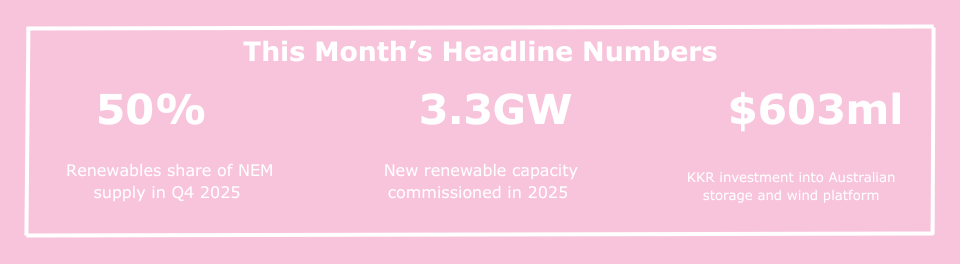
- 50%+ — Renewables share of NEM supply in Q4 2025 (AEMO)
- ~3.3 GW — New renewable capacity commissioned in 2025 (CEC)
- $603m — KKR investment into Australian storage and wind platform
- Watchlist for March 2026
- Early 2026 financial close data: is capital confidence returning?
- AEMO Integrated System Plan signals on transmission priority
- Federal budget signals on energy delivery incentives
Final Word
The transition isn’t slowing. But it is maturing.
The winners in 2026 won’t be those with the biggest pipelines. They’ll be those with the strongest delivery capability — technical, commercial, and political.
And right now, that capability is scarce.
Prepared by Freshwater Group. Helping companies secure leadership and critical talent for the energy transition.
- Posted by Freshwater Group
- On February 27, 2026
- 0 Comment