Opening snapshot
June marked a significant shift in Australia’s energy transition from building renewable generation to optimising the entire electricity system.
AEMO’s 2026 Integrated System Plan (ISP) confirmed that batteries are fundamentally changing the future grid, reducing the amount of new transmission required while reinforcing that wind deployment remains the biggest constraint to achieving Australia’s 2030 renewable energy ambitions. At the same time, AI-driven data centres emerged as the dominant new source of electricity demand, forcing governments, networks and developers to rethink how generation, transmission and major loads are coordinated.
Battery investment accelerated, corporate renewable procurement strengthened and policy increasingly shifted toward affordability, consumer protection and grid integration rather than simply adding renewable capacity.
Sources: RenewEconomy, RenewEconomy, PV Magazine Australia, AFR
Trendlines
- Batteries have become core grid infrastructure
The conversation has shifted decisively from “should we build batteries?” to “how should batteries reshape the electricity market?” Grid-forming batteries, household batteries and long-duration storage are increasingly replacing traditional system services while reducing transmission requirements.
- Data centres are becoming Australia’s largest new electricity customer
AI infrastructure dominated policy discussions throughout June. The debate has moved beyond simply connecting new loads to determining who funds the generation and transmission required to serve them.
- Wind, not solar, is now the critical constraint
Solar and batteries continue to exceed expectations. Wind development, planning approvals and construction remain the biggest risks to meeting Australia’s 2030 renewable electricity target.
- Investment is returning but becoming increasingly selective
Corporate PPAs, mining companies, batteries and hybrid projects are attracting capital while investors remain cautious around projects with planning, connection or cost uncertainty.
- Consumer affordability has become central to transition policy
Retail pricing, network tariffs, home batteries and distributed energy featured heavily as governments attempted to demonstrate tangible consumer benefits from the transition.
Noteworthy announcements / projects
1) AEMO releases the 2026 Integrated System Plan
What happened
AEMO’s latest ISP reduced the amount of transmission required compared with previous plans while confirming batteries will play a much larger role in balancing Australia’s future electricity system. However, it warned wind deployment remains significantly behind what is needed.
Why it matters
The transition is becoming less transmission-intensive but far more battery-intensive. The biggest delivery risk is no longer solar supply but getting enough wind projects approved and built.
2) Data centres reshape energy policy
What happened
Governments, Transgrid, developers and major corporates debated how AI data centres should contribute to renewable generation and transmission investment. Google advanced its first Australian renewable energy project to support its data centre operations while several proposals emerged requiring new data centres to fund additional clean generation.
Why it matters
Data centres have become one of the strongest drivers of future renewable investment, but also one of the biggest political risks if electricity costs are shifted onto households.
Sources: AFR, AFR AFR, RenewEconomy, RenewEconomy
3) Battery investment reaches another level
What happened
Fifteen new battery projects secured Capacity Investment Scheme contracts while multiple multi-gigawatt-hour battery developments received planning approval. Long-duration storage also continued gaining momentum.
Why it matters
Batteries are now Australia’s fastest-growing energy infrastructure asset class and increasingly underpin both investment and market design.
Sources: RenewEconomy, PV Magazine, ESD News
4) Corporate renewable procurement accelerates
What happened
Mining companies, technology firms and major industrial users continued driving renewable investment through PPAs and direct project support, helping restart solar investment after a slower period.
Why it matters
Private-sector demand is becoming almost as important as government policy in determining which projects reach financial close.
Sources: AFR, RenewEconomy
Hiring implications
The employment market continues to favour organisations capable of delivering projects rather than simply originating them.
Roles becoming harder to fill
- Battery trading and optimisation specialists
- Transmission planning and grid connection engineers
- Data centre energy strategy leaders
- Power systems engineers
- Renewable energy/BESS project directors
- Planning and environmental approvals specialists
Demand by sector
Data centres – energy procurement, grid strategy, major project delivery
Networks – system planning, transmission, connection engineering
Battery developers – trading, optimisation, commercial operations
Mining – renewable integration and electrification
Government and regulators – market design and consumer energy policy
Policy pulse
1) Consumer affordability dominates
Electricity pricing reforms, retailer conduct, network tariffs and consumer protections all became major policy priorities during June.
2) Data centre policy is moving rapidly
Governments are increasingly considering mechanisms requiring new AI infrastructure to fund additional renewable generation and transmission.
3) Delivery replaces ambition
Industry leaders increasingly acknowledge Australia’s targets remain achievable, but only if planning, approvals, transmission and workforce constraints improve materially.
Tech watch
- Grid-forming batteries continue moving into the mainstream.
- Sodium-ion batteries reached important commercial milestones internationally.
- AI increasingly being applied to grid planning and optimisation.
- Household batteries are evolving into active distributed grid assets.
Data points
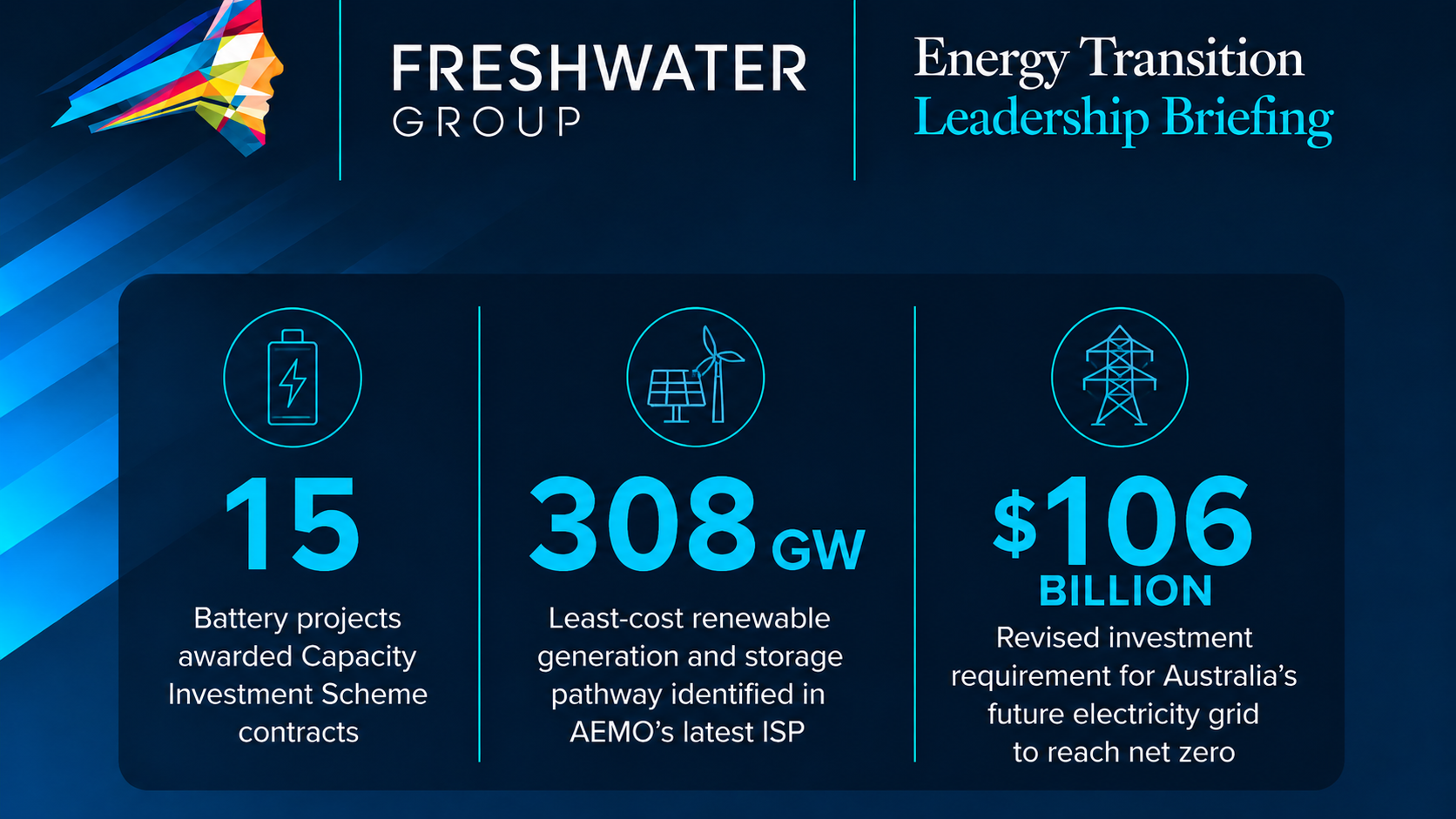
- 15 – Battery projects awarded Capacity Investment Scheme contracts.
- 308 GW – Least-cost renewable generation and storage pathway identified in AEMO’s latest Integrated System Plan.
- 106 billion dollars – Revised investment requirement for Australia’s future electricity grid to reach net zero.
Watchlist for July
- Data centre renewable funding requirements.
- Battery projects reaching financial close following CIS awards.
- Wind project approvals and planning reforms.
- Retail electricity pricing investigations.
- Delivery response to AEMO’s updated Integrated System Plan.
Final word
June reinforced that Australia’s energy transition has entered a more mature phase.
The debate is no longer whether renewables will dominate new generation investment. Instead, the focus has shifted to how batteries, transmission, major industrial loads and consumers can be integrated into a reliable and affordable electricity system.
The technology is increasingly proven.
The challenge is increasingly execution.
Prepared by Freshwater Group. Helping companies secure leadership and critical talent for the energy transition.